
Apple is hoping to assemble in India 25 per cent of all iPhones produced globally to reduce its heavy dependence on China.

If it splits now, who takes what away and leaves what behind? asks Shekhar Gupta.

Jeep India, a part of automotive group Stellantis, on Tuesday announced the opening of bookings for its upcoming SUV Meridian, the production of which has also commenced from its joint venture manufacturing facility at Ranjangaon, Maharashtra. Customers can book the Meridian either at Jeep India dealership network or through the company's website with a down payment of Rs 50,000. Deliveries of the vehicle will start in June, it said in a statement.
Jeep India, a part of automotive group Stellantis, on Tuesday announced the opening of bookings for its upcoming SUV Meridian, the production of which has also commenced from its joint venture manufacturing facility at Ranjangaon, Maharashtra. Customers can book the Meridian either at Jeep India dealership network or through the company's website with a down payment of Rs 50,000. Deliveries of the vehicle will start in June, it said in a statement.
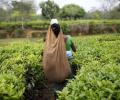
Madhu Jayanti's Rs 55-crore packet tea business so far is only in Maharashtra and Karnataka. After Eveready's tea business buyout, MJIL's tea production in India will increase from 2.4 million kg to 6.2 mkg and its income from branded tea sales will rise 53 per cent to Rs 198 crore this fiscal year itself. It will also be available in 14 states.

Two aborted missions, three different ministers, multiple rule changes and two decades later, Indian taxpayers will no longer have to pay Rs 20 crore per day to keep the loss-making Air India flying. While opposition Congress expectedly attacked the decision as selling the family silver, DIPAM secretary Tuhin Kanta Pandey said what Tata is getting is not a cash cow but an airline which is bleeding where money needs to be pumped in to refurbish obsolete aircraft and dust up strangled ones while being unable to touch any employee for one year and only be able to resize staff after paying a VRS. "It won't be a very easy task there. Only advantage is they (new Air India owner) are paying the price which they think they can manage. "They are not taking the excessive debt accumulated to fund years of losses. We are continuing it as an ongoing concern.... This process has also saved huge amount of taxpayers money going forward," Pandey told PTI.

Roselynn Raj speaks about the challenges of being a dusky-skinned model in the Indian fashion industry.
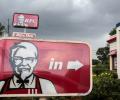
in the last three months, brands such as Tata Starbucks, KFC, and Pizza Hut have launched drive-through or kerb-side delivery services at their restaurants to catch consumers nervous about dining in.

Analysts have predicted a 23 per cent volume growth for the auto segment between FY22 and FY25, riding on the company's differentiated EV and SUV plan. M&M is already a market leader with a 36 per cent share in electric three-wheelers, and its Zaheerabad plant in Telangana is ready to cater to demand. In the farm segment, the company plans to focus on niche electric products.

After a long wait, the Shapoorji Pallonji Group has closed the sale process of its consumer durables business under the Eureka Forbes label by picking the American private equity fund Advent International's Rs 4,400-crore offer for a 72 per cent stake. The sale process, which began in November 2019, will help the over 156-year-old SP Group pair the debt pile and sharpen the focus on the flagship construction and engineering business under Afcons. The valuation of Rs 4,400 crore for a 72.56 per cent stake is is at an enterprise level and subject to closing adjustments and also includes an open offer for the remaining stake after the demerger and listing of Eureka Forbes, the SP group said in a statement on Sunday.

The Virtus is indeed designed to look, act and behave like a well-built European sedan that swims in the segment between the compact sedan VW Vento and the larger Passat, says Pavan Lall.

If reports that Apple Inc plans to triple its iPhone production in India come true, it is likely to help the country become a supply hub for the American company. There are some 190 Apple suppliers globally, but only 12 have manufacturing facilities in India now. Apple's strategy is to focus on India and a clutch of other countries as it diversifies its supply chain out of China.

'Some of the launches may get deferred due to the semiconductor shortage, which is unlikely to get resolved before the second half of 2022.'

'But we are much better than what we all had expected and planned, and what all the prophets of doom had predicted.'

The attack on Dabur comes days after Fabindia was pilloried for naming its collection 'Jashn-e-Riwaaz'.

If that happens, Jet Airways will be the first bankrupt airline which will be revived under the Insolvency process.

India's largest software services company Tata Consultancy Services (TCS) on Wednesday it has seen a surge in demand for its services and expects to recruit 10,000 individuals in the US by 2022. The Mumbai-based company has hired over 21,500 employees in the past five years in the US.

Minister of State for Civil Aviation Jayant Sinha emphasised that the brand name has both sentimental and economical value.

'For all of us at Amazon, it is 'Bharat first'.' 'We are keeping the Indian customer at the centre of what we are doing.'


What do we need more of: Leaders who dominate global institutions or local leaders with a 'Make-in- India' mindset?

'A lot of people who quit felt they have been in the organisation for way too long and needed a better or challenging career role to advance in their careers.'

No Indian auto brand (including Tata or Mahindra) is well-known globally.

The electric vehicle evolution in India's passenger vehicle market has remained frozen in time and may see limited adoption over the next decade, experts say.

India's wrestlers received a welcome boost ahead of this month's Asian Games after the federation got automaker Tata Motors as their principal sponsor on Wednesday.

With a revival in demand and consumption, FMCG companies are looking forward to 2022 with positivity and hopes of sustaining a healthy growth trend across both rural and urban markets while gearing up to cater to the ever-increasing digitally active consumers and tackle the challenge of higher commodity prices. Health and wellness and convenience are going to remain key trends and FMCG companies are strengthening their core brands, driving premiumisation across their portfolios with targeted innovations as consumers are gravitating towards trusted brands looking for quality, purity and hygiene, in continuation of the trend that started since the pandemic last year. FMCG makers are accelerating digitalisation and are investing in building capability in e-commerce and Direct-to-Consumer channels, identifying it as a key vector of their growth as the threat of a possible third wave is still not away.
Launch will be under separate brand name

The Mahindra's Scorpio-N becomes the first body-on-frame chassis SUV to secure a five-star Global NCAP rating.

PharmEasy has acquired Medlife for an undisclosed amount, the e-pharmacy unicorn said on Tuesday. The deal will make PharmEasy the largest player in the domestic online pharmacy sector, with the combined entity set to serve 2 million customers a month.

Tucked away at a lane in Arehalli Guddadahalli, a small village in Bengaluru Rural district is a nondescript factory of LaundryMate, one of India's first organised technology-led online laundry services firms. The company has built the country's largest laundry facility, which is spread across 53,000 square feet - the size of a football field. Inside the hangar-like building, one can hear the whooshing and humming sound of big hi-tech washing machines being operated by the newly-recruited staff of LaundryMate.
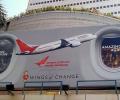
Tata Group-owned Air India CEO Campbell Wilson on Saturday apologised for a flyer urinating on a fellow female passenger on a flight from New York in November, and said four cabin crew and a pilot have been de-rostered and the airline is reviewing policy of serving alcohol on flights.

The all-new ZS EV will be available in two variants -- Excite and Exclusive, priced at Rs 21.99 lakh and Rs 25.88 lakh, respectively. The company said it has initiated bookings for the Exclusive variant, while bookings for the Excite trim will commence from July 2022. The model comes with the largest in-segment 50.3-kWh (kilowatt-hour) battery with advanced technology, offering a 461-km certified range in a single charge.

The world is full of family businesses that withered away with the passing of generations, creating much bitterness and ill will. Entire clans that used to be household names have become pale shadows of their once-mighty empires.
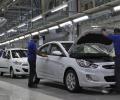
Leading carmakers Maruti Suzuki, Hyundai and Tata Motors reported robust dispatches to dealers in May on the back of strong demand for passenger vehicles across regions, even as the global semiconductor shortage continued to impact production. Mahindra & Mahindra, Kia India, Toyota Kirloskar Motor, Honda Cars and Skoda also witnessed strong demand for their models last month. The month of May also witnessed Tata Motors race ahead of Hyundai in terms of domestic wholesales.

'If you try to use every resource that you have, you won't feel like you've let yourself down. Don't think because wherever you came from that you cannot be successful. No matter if you make an Olympic team, you gave your heart and you put your heart out there to be as successful as you could be.'

Passenger vehicle market leaders Maruti Suzuki and Hyundai on Saturday reported a decline in wholesales in December 2021, although homegrown majors Tata Motors and Mahindra & Mahindra reported growth, amid semiconductor shortage continuing to impact production. Other manufacturers Nissan and Skoda also reported an increase in December 2021 sales although Honda Cars India witnessed a decline last month. The country's largest carmaker Maruti Suzuki India (MSI) reported a 4 per cent fall in wholesales to 153,149 units in December 2021 as against 160,226 units a year ago.

According to Randstad Employer Brand Research (REBR) 2020, Microsoft India scored high on financial health, strong reputation and utilisation of the latest technologies. Others in the top 10 list are Samsung, Amazon, Infosys, Mercedes-Benz, Sony, IBM, Dell, ITC and TCS.

'If it is your second car (electric vehicle), you typically keep it for travel within the city.' 'And the first car (internal combustion engine-run vehicles) can then be used to travel to some other cities.'

'Consumers are willing to increase travel spends by 20-30 per cent versus pre-pandemic.'

Maruti Suzuki India is eyeing a leadership position in the SUV segment as it continues to add new products across various sub segments, a top company official said on Wednesday. The country's largest carmaker has bolstered its presence in the high volume entry and mid level SUV segments with new Brezza and all new model -- Grand Vitara. "In every segment except SUV, we are the market leader by a distance. "It is only in the SUV that we are behind, so we need to catch up. Clearly, we have to become number one in the SUV space also," Maruti Suzuki India MD and CEO Hisashi Takeuchi said in an interaction on the sidelines of the global unveiling of Grand Vitara.
